Yes. While electricians don't replace your internet provider, we can often improve how your network reaches connected electrical equipment.
In this project near Crediton, we extended the customer's existing internet connection to provide reliable Wi-Fi coverage at their Pod Point EV charger using outdoor networking equipment designed for permanent installation.
Reliable connectivity helps ensure connected devices continue to operate as intended and remain ready for future software updates and smart features.
Often, yes.
Extending reliable Wi-Fi outdoors can improve connectivity for gardens, workshops, garages and other external areas, depending on the property's layout and internet service.
Designing the network around how the property is used helps provide the best overall coverage.
Modern electrical installations increasingly involve connected technology.
Installing network infrastructure alongside electrical work allows connected equipment to operate more reliably while keeping installations neat, practical and easier to expand in the future.
Considering both power and connectivity together can provide a better long-term solution.
The customer wanted to prepare for the possibility of future smart energy devices making greater use of the home's own network.
Providing reliable Wi-Fi near the meter location was a practical way to future-proof the installation without needing further work later.
Planning ahead during electrical projects can often be more cost-effective than retrofitting additional infrastructure.
Yes.
Planning network infrastructure during electrical work can make it easier to add future connected technologies without significant alterations later.
As more electrical equipment becomes internet-connected, having reliable coverage where devices are installed can help simplify future upgrades.
It can be when correctly selected and installed.
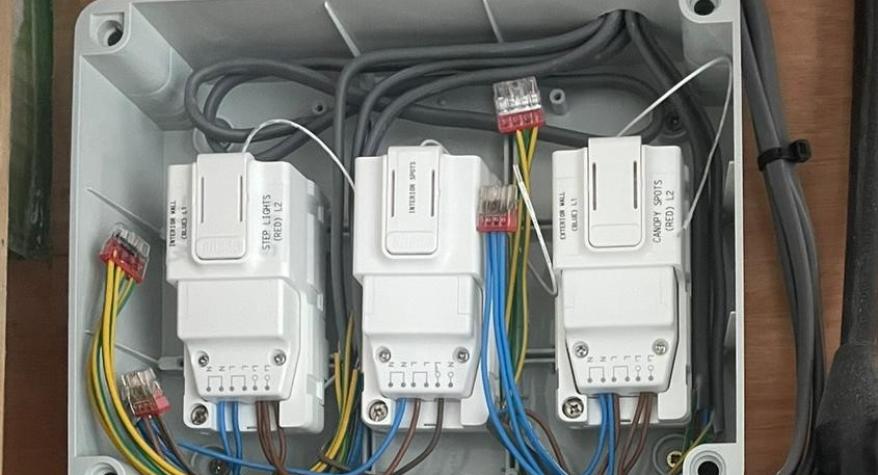
For this project, the equipment was housed within weatherproof enclosures using a robust "box within a box" approach to provide additional protection from the elements and support long-term reliability.
Proper installation is just as important as the equipment itself.
Power over Ethernet (PoE) allows both electrical power and network data to be delivered through a single Ethernet cable.
This removes the need for separate power supplies next to each wireless access point, resulting in a cleaner installation with fewer components exposed to the weather.
For this project, reliability was the priority.
Instead of repeatedly relaying an existing wireless signal, the network was extended using Ethernet cable before new wireless access points were installed.
This provides a much stronger and more dependable connection, particularly for permanently installed electrical equipment.
Yes.
Traditional stone buildings are common across Devon and can significantly reduce wireless signal strength.
Even if your broadband connection is working well, the Wi-Fi may not reliably reach garages, meter cupboards, outbuildings or EV chargers.
Extending the network using wired infrastructure and professionally positioned wireless access points is often far more reliable than simply adding plug-in signal boosters.
Increasingly, many electrical products rely on network connectivity.
Examples include:
- EV chargers
- Energy monitoring systems
- Home automation
- Smart energy devices
Reliable Wi-Fi can improve communication between these devices and their associated apps or online services, helping homeowners get the most from modern electrical technology.
Yes.
Many rural properties rely on mobile broadband or other internet connections instead of fibre. Modern connected electrical equipment doesn't necessarily require fibre — it simply needs a stable internet connection.
In this installation, the customer used an EE cellular broadband connection, which was distributed around the property to improve coverage where it was needed.
In many cases, yes.
If electrical work is already taking place, it can be an ideal opportunity to consider where reliable network connections may be useful in the future.
Thoughtful planning can reduce the need for additional work later while helping modern electrical systems perform more reliably.