An EICR in Holbeton Raised a Simple Question About the Electric Shower
When preparing a property for sale, most homeowners understandably want any electrical issues identified during an Electrical Installation Condition Report (EICR) dealt with sensibly and without spending money unnecessarily.
That was the situation for a customer in Holbeton, Devon, where an EICR identified that the electric shower circuit did not have RCD protection.
The customer’s initial question was straightforward: could suitable RCD protection simply be added to the existing installation?
The answer was potentially yes.
Adding appropriate protection to an existing circuit can be a perfectly reasonable solution, and the fact that a consumer unit is older does not automatically mean it needs replacing.
However, once we looked at this particular installation as a whole, the conversation became less about whether another modification could be made and more about whether that was where the customer wanted to invest their money.
When Is Modifying an Older Consumer Unit in Holbeton Still a Sensible Option?
Older consumer units can often remain in service and be appropriately modified where their condition, arrangement and compatibility allow it.
An unsatisfactory EICR does not automatically mean the consumer unit needs replacing either. The purpose of the report is to identify the condition of the installation and the defects requiring attention. How those defects are then resolved depends on what has actually been found.
For the electric shower at this Holbeton property, addressing the lack of RCD protection individually was therefore an option worth considering.
If the rest of the installation had been relatively straightforward, that may have represented a proportionate way forward.
But this installation had another important characteristic.
Why the Existing Consumer Unit Arrangement Changed the Discussion
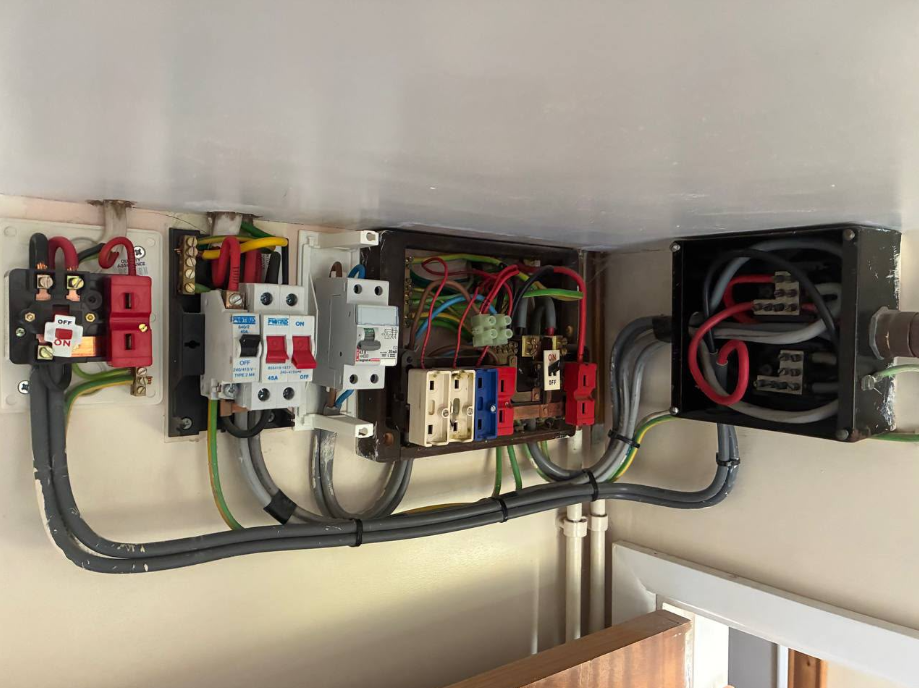
Over many years, the original Wylex consumer unit had been joined by several separate pieces of switchgear.
There was separate RCD protection, dedicated shower switchgear, separate garage isolation and other additions associated with the installation.
There was nothing unusual about an electrical installation evolving in this way. Properties change, new circuits are required and electrical standards develop. Each addition may have served a perfectly valid purpose when it was installed.
The issue was not simply that the arrangement looked older or less tidy than a modern consumer unit.
The important question was what another modification would achieve.
Adding another solution would rectify the immediate shower protection issue, but it would also mean investing further money into an arrangement that had already accumulated several individual additions.
That changed the conversation with the customer.
Instead of asking:
“Can we add RCD protection to the shower?”
the more useful question became:
“Is another modification really the best place to spend the customer’s money?”
Consumer Unit Replacement in Holbeton Was About Long-Term Value, Not Simply Age
This distinction is important because consumer unit replacement should not be treated as the automatic answer whenever older equipment is encountered.
Sometimes modifying an existing installation is exactly the right decision.
On other installations, however, the cumulative cost and complexity of continuing to address requirements individually begins to change the value calculation.
We discussed both approaches with the customer so they could consider the immediate cost against what each option would leave them with afterwards.
In this case, the customer decided they would rather invest in the electrical installation as a whole than pay for another individual modification.
The decision to replace the consumer unit was therefore not based simply on its age, its appearance or the fact that the EICR was unsatisfactory. It came from considering the complete arrangement and deciding which option represented better long-term value for this particular property.
How a Modern Consumer Unit Simplified the Holbeton Electrical Installation
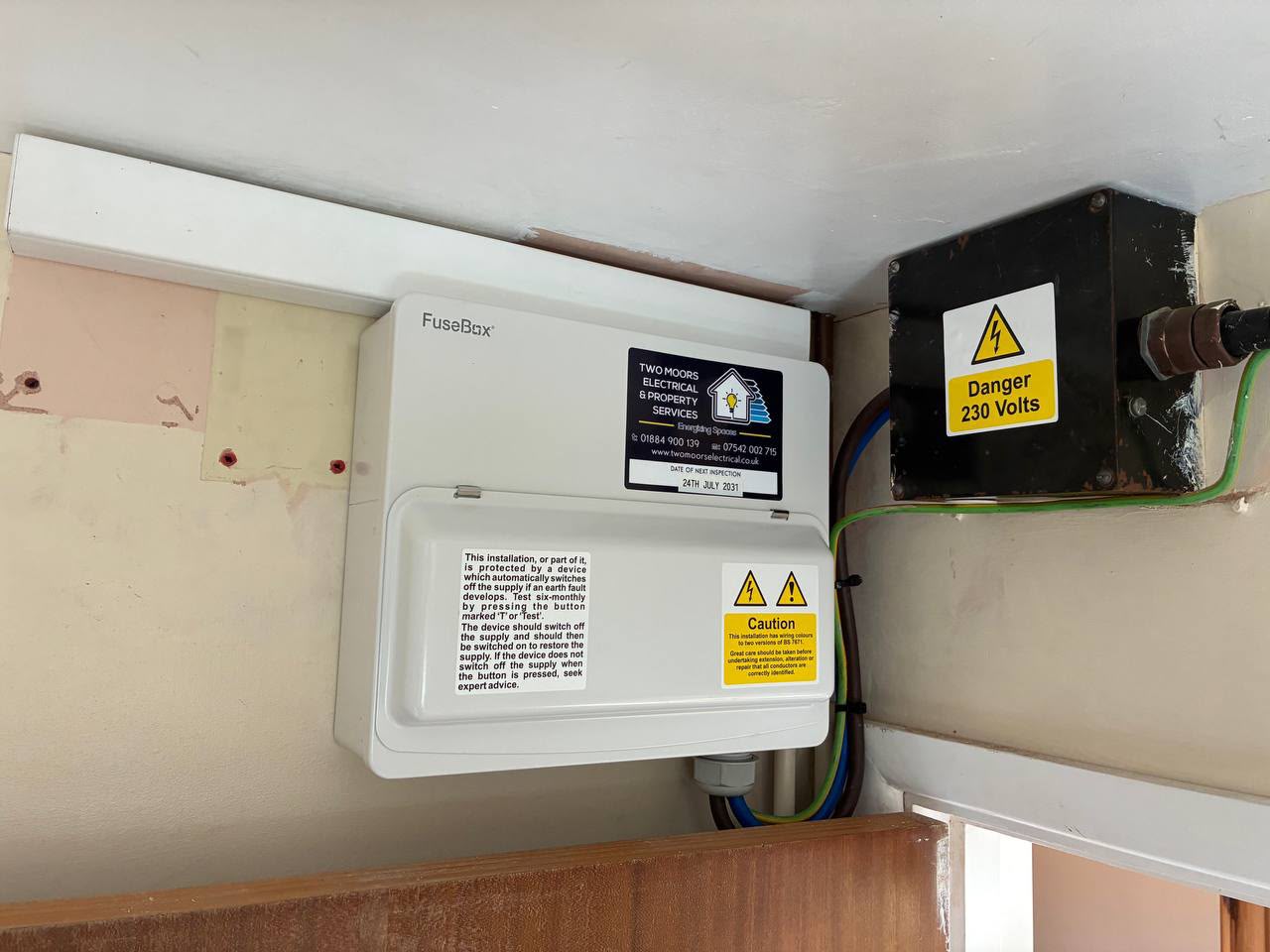
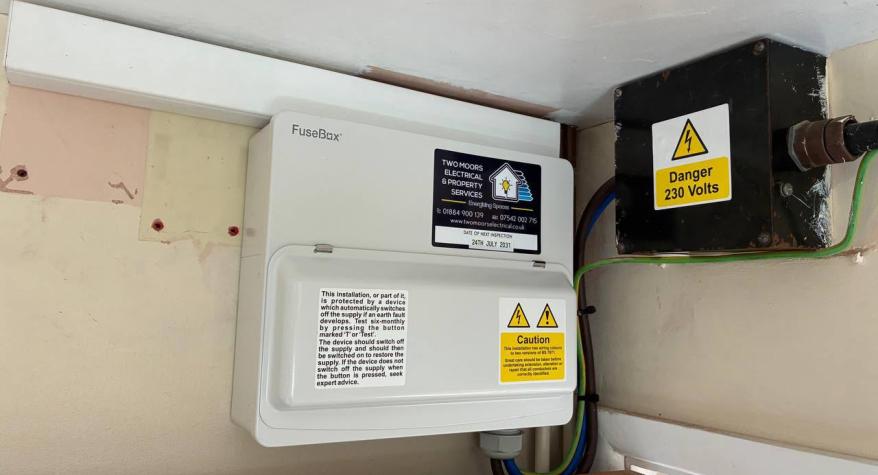
The existing arrangement was replaced with a modern consumer unit providing individual RCBO protection and surge protection.
Individual RCBOs mean that each circuit has its own combined protection against overcurrent and residual current faults. One practical benefit is that a fault affecting one circuit does not have to remove RCD protection from a group of otherwise healthy circuits in the way some older shared-RCD arrangements can.
Surge protection provides an additional layer of protection against transient overvoltages that could potentially damage sensitive electrical and electronic equipment within the property.
Just as importantly for this project, the replacement allowed much of the protection that had accumulated across separate pieces of equipment to be brought together into a clearer and more organised arrangement.
The benefit shown in the before-and-after photographs is therefore not simply cosmetic. They illustrate the difference between continuing to add individual solutions and taking an opportunity to simplify the installation as a whole.
Cheapest Consumer Unit Repair or Best Long-Term Value – How Should Homeowners Decide?
There is no single answer that applies to every property.
A relatively small modification to an existing consumer unit may provide exactly what is required and could represent excellent value.
Equally, there are installations where repeatedly adding separate equipment eventually becomes less attractive when compared with replacing the protective arrangement and creating a better foundation for future maintenance and alterations.
Good electrical advice means understanding that distinction.
For this property in Holbeton, Devon, the customer’s immediate concern was one circuit identified during an EICR. Looking beyond that individual defect allowed them to compare the options in the context of the entire installation rather than making the decision on the shower circuit alone.
That is where professional judgement becomes important: not automatically recommending the cheapest repair and not automatically recommending replacement, but explaining what each option achieves so the customer can decide where their money is best spent.
Consumer Unit Replacement in Holbeton, Devon
An older consumer unit does not automatically need replacing, and an unsatisfactory EICR does not automatically mean wholesale replacement is required.
Individual remedial work can often be the sensible and proportionate answer.
This particular installation in Holbeton, Devon reached a point where the customer decided that another individual modification was no longer where they wanted to invest their money. Replacing the existing arrangement addressed the shower protection identified during the EICR while also providing individual RCBO protection, surge protection and a simpler foundation for the future.
The important lesson isn’t that replacement is always better. It’s that the cheapest immediate solution and the best-value long-term solution are not necessarily the same thing.
Knowing the difference comes from looking at the installation as a whole, understanding the available options and helping the customer make an informed decision about what represents the best investment for their property.
Frequently Asked Questions:
Should I Modify or Replace an Older Consumer Unit?
If an EICR identifies a problem with an older consumer unit, it doesn’t automatically mean the whole consumer unit needs replacing.
In many installations, an individual defect can be addressed safely and appropriately by modifying the existing arrangement. In others, particularly where several additions have accumulated over time, it can be worth comparing the cost and limitations of another modification with the benefits of replacing the protective arrangement as a whole.
The important question isn’t simply how old the consumer unit is. It’s whether the existing installation remains suitable, what work is required and where your money is best spent.
Below are answers to some of the questions homeowners commonly have when deciding whether to modify or replace an existing consumer unit.
Does an old consumer unit automatically need replacing?
No.
The age of a consumer unit alone does not determine whether it needs to be replaced. Older equipment can remain in service where its condition, arrangement and protective measures remain suitable.
An electrician should assess the installation itself rather than recommending replacement simply because a newer type of consumer unit is now available.
Why it matters: Older does not automatically mean unsafe. The decision should be based on the actual condition and suitability of the installation.
Does an unsatisfactory EICR mean I need a new consumer unit?
No. An unsatisfactory Electrical Installation Condition Report (EICR) does not automatically mean the consumer unit needs replacing.
An EICR assesses the condition and safety of the electrical installation. If defects are identified, the appropriate remedial work depends on what those defects are.
Sometimes an individual issue can be corrected without replacing the consumer unit. In other circumstances, the overall condition or arrangement may make replacement worth considering.
Why it matters: The purpose of an EICR is to identify electrical safety issues, not automatically generate a recommendation for a new consumer unit.
Related information: Electrical Installation Condition Reports (EICRs)
If one circuit fails an EICR, does the whole consumer unit need replacing?
Not necessarily.
A defect affecting one circuit may be capable of being rectified independently while the remainder of the consumer unit stays in service.
For example, the EICR at a property we worked on in Holbeton identified that an electric shower circuit did not have RCD protection. It was potentially possible to provide suitable protection without replacing the entire consumer unit.
The decision to replace the consumer unit came only after considering the wider protective arrangement and discussing the available options with the customer.
Why it matters: Individual defects should be assessed individually. One problem does not automatically condemn the entire consumer unit.
Can RCD protection be added to an existing consumer unit?
In some installations, yes.
There are circumstances where suitable RCD protection can be added without replacing the complete consumer unit. Whether this is appropriate depends on the existing equipment, its condition, compatibility and the design of the installation.
An electrician needs to assess the particular installation before determining the most suitable approach.
Why it matters: Adding protection to an existing installation can sometimes be a perfectly reasonable and cost-effective solution. Replacement should not be assumed to be necessary.
When should I consider replacing my consumer unit instead of modifying it?
Replacement becomes worth considering when the installation as a whole means that continuing to make individual modifications may no longer represent the best long-term solution.
This could include an installation that has accumulated several separate pieces of protective equipment over many years, or where further modifications would add additional cost and complexity without addressing the wider limitations of the existing arrangement.
That still doesn’t automatically mean replacement is required. The costs and benefits of both approaches should be compared.
Why it matters: The cheapest immediate repair and the best-value long-term solution are not always the same thing.
Is it safe to keep adding separate protection to an older electrical installation?
It can be.
Separate protective devices and additions are not inherently unsafe. Many will have been installed for perfectly valid reasons as the electrical installation developed over time.
However, as more equipment is added, there may eventually be value in assessing the protective arrangement as a whole rather than automatically installing another separate solution.
Why it matters: The number of electrical boxes isn’t what determines safety. Their condition, suitability, coordination and the overall design of the installation are what matter.
Why do some older electrical installations have several separate electrical boxes?
Electrical installations often evolve alongside the property.
A homeowner may add an electric shower, garage supply or another circuit years after the original consumer unit was installed. Separate protective equipment may then have been installed to accommodate those additions.
Over several decades, this can result in an original consumer unit being surrounded by additional RCDs, isolators or other switchgear.
Why it matters: An installation that has evolved over time isn’t automatically unsafe or poorly installed. However, its overall arrangement should be considered when further alterations are proposed.
What is an RCBO and what does it do?
An RCBO is a protective device that combines overcurrent protection with residual current protection for an individual circuit.
In a modern consumer unit using individual RCBOs, a fault affecting one circuit can generally operate the protection for that circuit without relying on one shared RCD protecting several circuits.
Why it matters: Individual circuit protection can provide a more organised protective arrangement and can reduce the number of circuits affected by certain electrical faults.
The presence of RCBO technology does not, by itself, mean an older consumer unit needs replacing.
What is surge protection and why is it fitted in modern consumer units?
Surge protection is designed to reduce the risk of damage to electrical and electronic equipment caused by transient overvoltages.
Modern homes contain increasing amounts of sensitive electronic equipment, from televisions and computers to heating controls and connected electrical devices.
A Surge Protective Device (SPD) can form part of the protective measures within a modern electrical installation.
Why it matters: Surge protection provides an additional form of protection, but the availability of an SPD in a new consumer unit is not, on its own, justification for replacing an otherwise suitable existing consumer unit.
Is a new consumer unit safer simply because it is newer?
Not necessarily.
Modern consumer units can incorporate protective features and arrangements that may not be present in older installations, but age alone does not determine electrical safety.
An older consumer unit that remains suitable for the installation should not automatically be considered unsafe simply because newer equipment exists.
Likewise, fitting a new consumer unit does not remove the need for the rest of the electrical installation to be properly assessed, tested and maintained.
Why it matters: Electrical safety should be based on the condition and suitability of the complete installation rather than the age or appearance of one component.
Can an older consumer unit still receive a satisfactory EICR?
Yes.
An EICR assesses the condition of the electrical installation against the relevant safety requirements. It isn’t simply an inspection of how modern the equipment looks.
An older consumer unit does not automatically result in an unsatisfactory report.
Any observations should relate to genuine issues identified during the inspection and be appropriately classified.
Why it matters: An EICR is an assessment of electrical safety and condition, not an automatic requirement to bring every part of an older installation up to the specification of a brand-new one.
How does an electrician decide whether modification or replacement is appropriate?
The electrician should consider the installation as a whole.
This can include the condition and suitability of the existing equipment, the defect or alteration being addressed, the protective arrangements already present, compatibility of equipment, the extent of previous additions and what the customer wants to achieve.
The available options can then be explained so the customer understands what each approach will and won’t achieve.
Why it matters: There is no single rule that applies to every older consumer unit. Professional judgement should be based on the individual installation rather than age or appearance alone.
Is replacing a consumer unit always more expensive than carrying out remedial work?
Not necessarily, although replacing the complete consumer unit will often involve more work than addressing a single straightforward defect.
The important comparison is between the complete costs and benefits of the available options.
If one relatively simple modification resolves the issue appropriately, replacement may offer little benefit. If several alterations are required or the existing arrangement has significant limitations, the difference in overall cost may justify considering a more comprehensive solution.
Why it matters: Comparing options rather than simply comparing headline prices helps homeowners understand what they’re actually paying for.
Why might replacing a consumer unit offer better long-term value?
Replacement can sometimes consolidate several pieces of existing protective equipment into a clearer arrangement while providing a suitable foundation for future maintenance and alterations.
That was the decision made on the Holbeton project. Although the immediate shower protection issue could potentially have been addressed separately, the installation had accumulated several additions around the original consumer unit.
After considering both options, the customer chose to invest in replacing the overall protective arrangement rather than adding another individual modification.
Why it matters: Better long-term value doesn’t necessarily mean choosing the most expensive option. It means considering what each option achieves both immediately and over the longer term.
Does an untidy-looking consumer unit arrangement mean it is unsafe?
No.
Appearance alone isn’t a reliable way to determine whether an electrical installation is safe.
Older installations can accumulate separate pieces of switchgear as circuits and equipment are added over the years. This may look less organised than a modern consumer unit while still containing additions that were entirely appropriate when installed.
An electrical assessment should consider the actual condition, protection and arrangement rather than judging the installation purely by appearance.
Why it matters: Electrical safety decisions should be based on evidence and testing, not simply on whether an installation looks old or untidy.
What should I consider if an EICR identifies electrical work before selling my property?
Start by understanding exactly what the EICR has identified and what remedial work is required.
Ask what options are available, whether individual defects can be addressed independently and whether any wider improvements are being recommended rather than required.
If replacement of the consumer unit is being considered, it is reasonable to understand what replacing it would achieve compared with modifying the existing installation.
Why it matters: When preparing a property for sale, it’s understandable to want to avoid unnecessary expenditure. A clear explanation of the available options allows you to make an informed decision about where your money is best spent.
How do I know whether modifying or replacing my consumer unit is the better option?
There isn’t a universal answer.
Sometimes modifying an existing consumer unit is entirely appropriate and provides a safe, sensible and cost-effective solution.
Sometimes the condition, arrangement and limitations of an installation mean replacement represents better long-term value.
The correct decision comes from assessing the installation as a whole, understanding what work is actually required and comparing what each available option will achieve.
Why it matters: A good recommendation shouldn’t begin with the assumption that an older consumer unit needs replacing. It should begin with understanding the installation and helping you make an informed decision.
Get in touch today to enquire about a Consumer Unit Replacement in Holbeton, Devon