A customer at a property in Nomansland wanted to update their existing downlights. They wanted the new lighting to be dimmable, and they also mentioned that one particular GU10 lamp had been repeatedly failing.
Two Moors Electrical Replacing GU10 Downlights with Integrated LED Downlights in Mid Devon
Neither point automatically meant that all of the existing downlights needed replacing.
Dimmable GU10 lamps are readily available, so if dimming had been the only consideration, retaining the existing fittings and installing suitable lamps could have been an option.
The recurring lamp failure was worth investigating rather than simply assuming that another bulb was needed, but there was no evidence at this stage to justify blaming a particular component.
It was only when we looked more closely at the existing installation that the wider considerations became apparent.
This is where replacing older downlights can become more involved than it first appears. A homeowner naturally sees the lamp and bezel below the ceiling. To select the right replacement, we also need to understand what’s happening above it.
GU10 vs Integrated LED Downlights – What’s Actually Above the Ceiling?
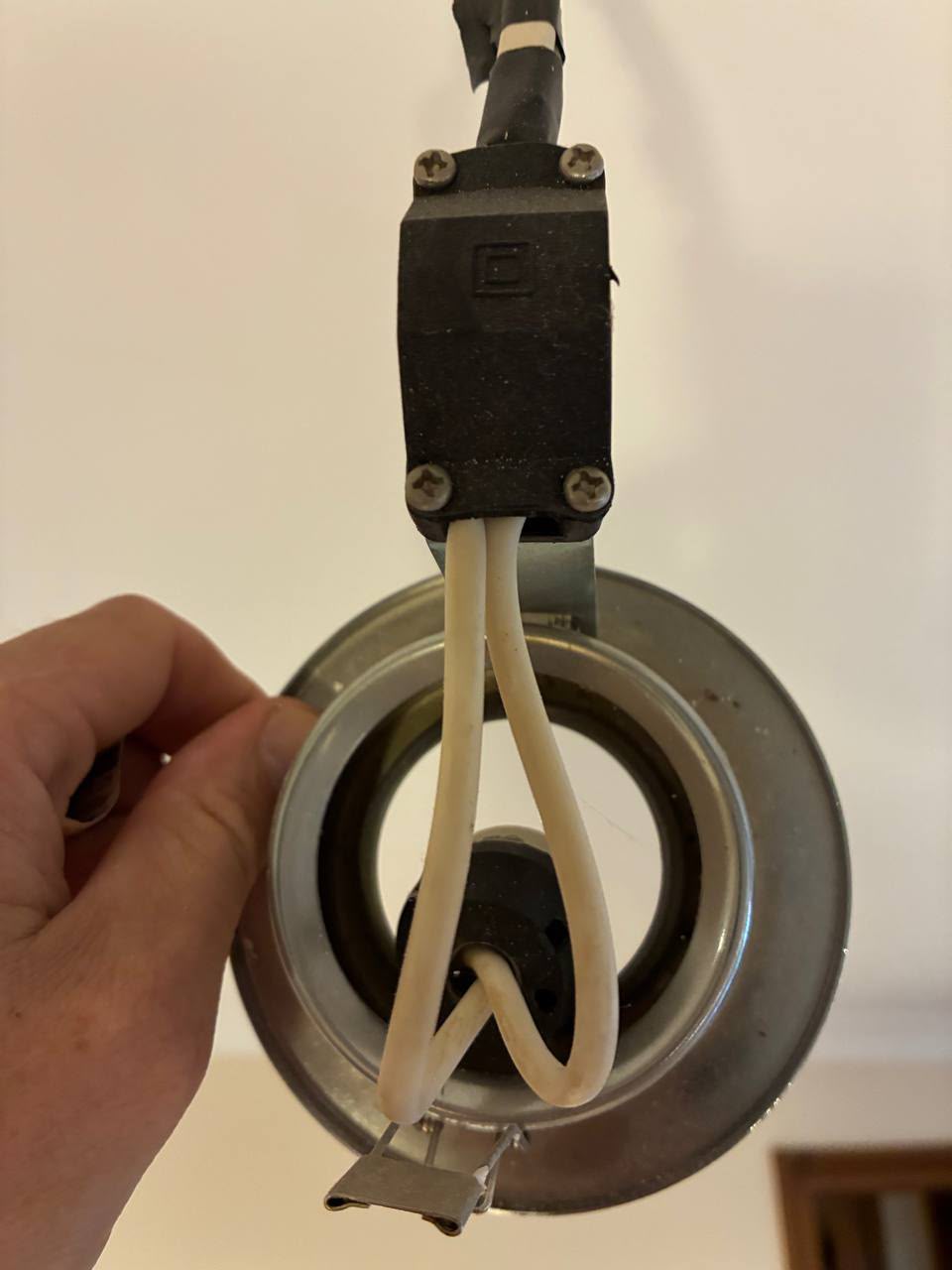
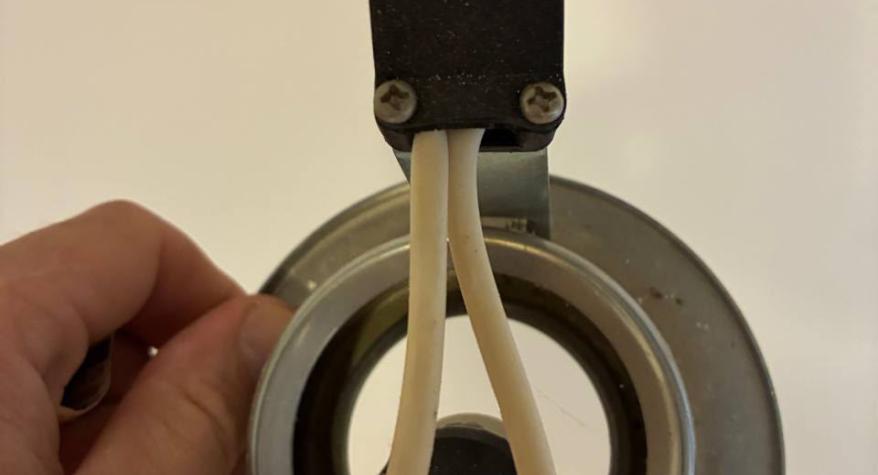
A traditional GU10 downlight normally consists of a fitting containing a separate GU10 lampholder. The lamp twists into that holder and can be removed independently when it eventually fails.
The photographs from this Nomansland installation show the construction that is normally hidden above the ceiling, including the downlight body, ceramic GU10 lampholder, wiring and associated components.
That replaceable lamp is one of the genuine advantages of the GU10 arrangement. If a lamp reaches the end of its life, it can normally be changed without replacing the complete fitting.
An integrated LED downlight works differently. Rather than using a separate replaceable GU10 lamp, the LED light source and associated components form part of the complete fitting.
Depending on the particular product, integrated downlights can offer useful features such as dimming, selectable colour temperature, different selectable outputs, shallower fitting depths or suitable fire-rated construction.
Those features are product-specific, however. They should be checked when selecting the fitting rather than assumed simply because a downlight is described as integrated LED.
There is also a trade-off. If an integrated component eventually fails, replacement of the complete downlight may be required.
Neither design is automatically the right answer for every property.
Why a GU10 Lamp That Keeps Failing Should Be Investigated
One of the customer’s original concerns was the GU10 lamp that had repeatedly failed.
It’s easy to view repeated lamp failure as bad luck and simply fit another lamp, but when the same position is repeatedly causing problems, it’s sensible to look more closely.
Depending on the installation, an electrician may need to consider the fitting, electrical connections, heat conditions, lamp compatibility and other possible factors.
In this case, the recurring failure formed part of the reason for assessing the existing arrangement. We did not establish from that observation alone that the lampholder, fitting or any other individual component was definitely at fault.
That distinction matters.
Professional assessment isn’t about choosing an explanation before investigating. It’s about recognising when a recurring symptom deserves more attention.
Do Replacement Downlights in Mid Devon Need to Be Fire-Rated?
Another consideration became apparent when the existing fittings were inspected.
The older downlights were not fire-rated and were installed within a ceiling with living accommodation above.
That does not mean every downlight beneath another room automatically has to be fire-rated.
The relevant consideration is whether the ceiling forms part of a required fire-resisting construction. Where it does, openings through that ceiling and the fittings installed within them need to be appropriately considered so that the required fire performance is maintained.
Downlights create penetrations through the ceiling, so understanding the construction in which they are being installed is an important part of selecting an appropriate replacement.
For this project, fire performance therefore became one of the factors considered alongside the customer’s requirement for dimming and the physical dimensions of the existing installation.
Why the Existing 70 mm Ceiling Cut-Out Mattered When Choosing the New Downlights
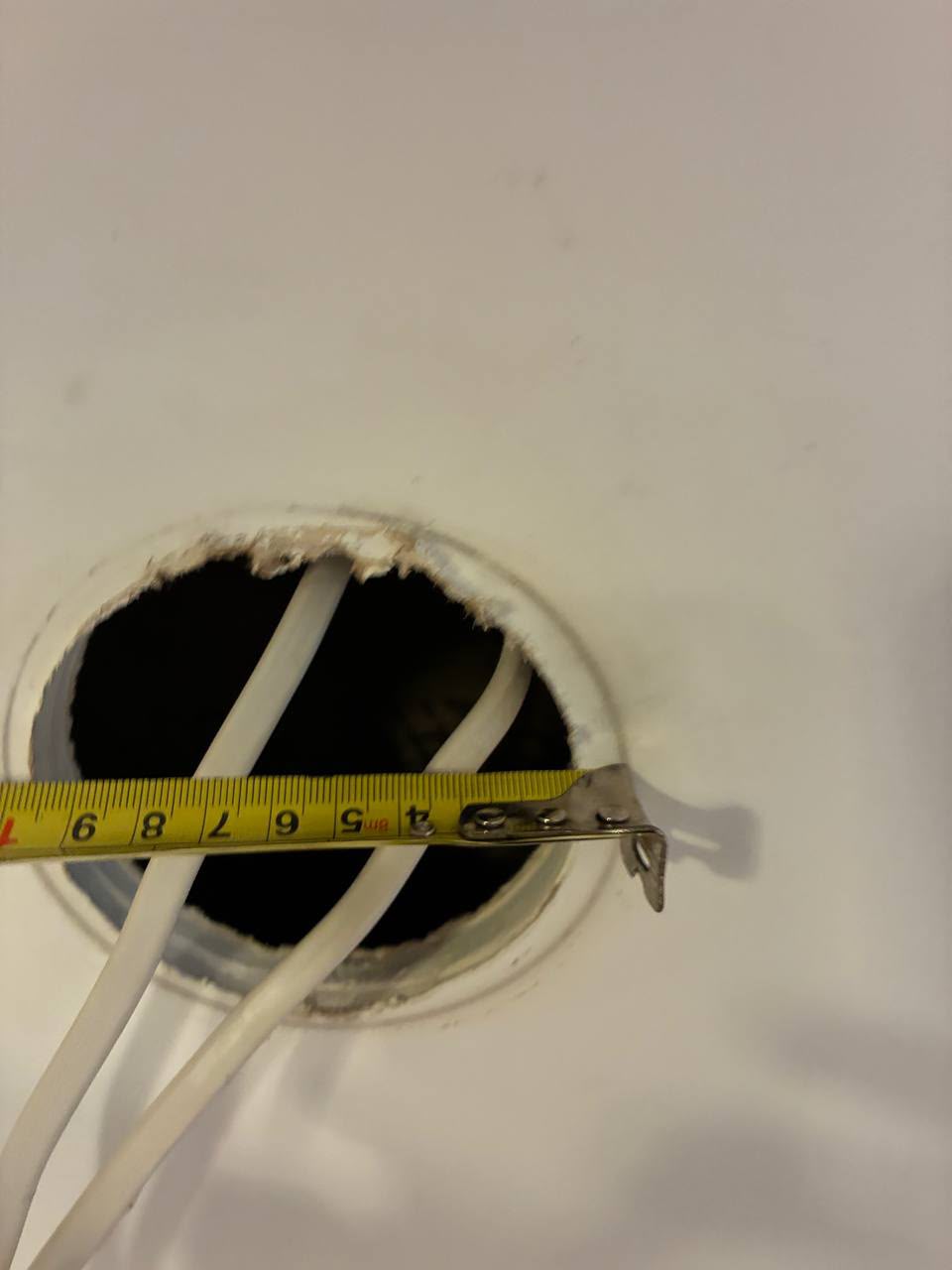
Before ordering the replacement fittings, we measured the existing ceiling openings.
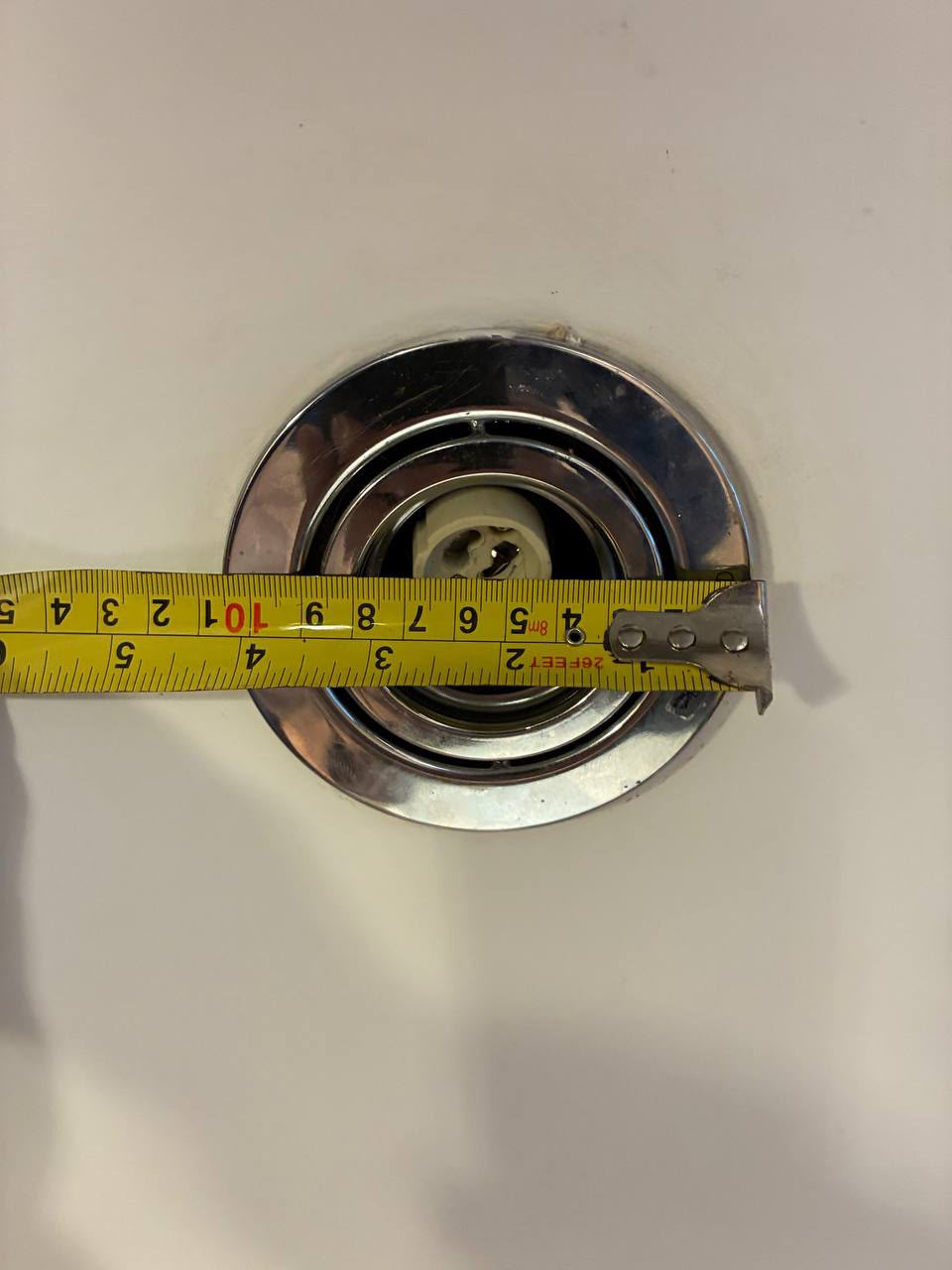
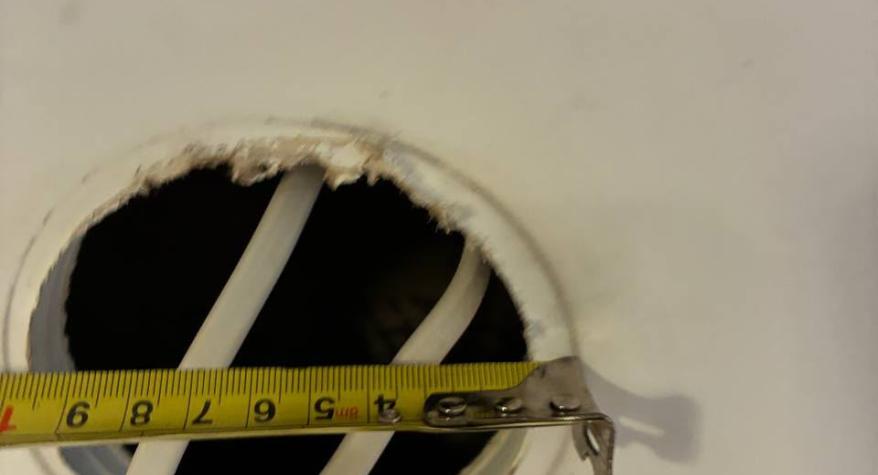
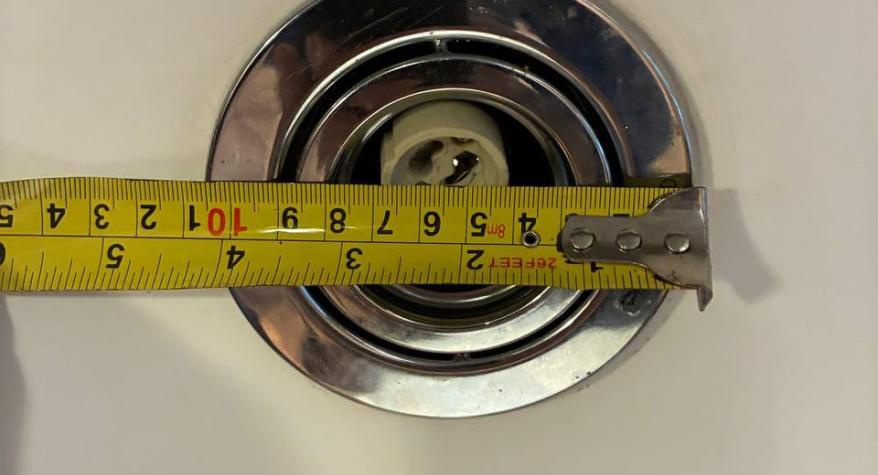
The photographs show an opening of approximately 70 mm.
That measurement might seem like a small detail, but it has a direct effect on which replacement fittings are suitable.
The new downlight needs to be compatible with the existing cut-out. The bezel also needs to be large enough to properly cover the opening and any marks left by the previous fitting.
A downlight can be electrically suitable and provide exactly the lighting characteristics the customer wants, yet still be the wrong replacement if it doesn’t physically fit the existing ceiling.
Selecting the fitting first and measuring afterwards can turn what should have been a straightforward replacement into unnecessary ceiling alterations or making good.
Why Downlight Depth, Ceiling Voids and Existing Conditions Need Checking
Cut-out diameter isn’t the only physical measurement that matters.
The available depth above the ceiling also needs to be considered. Different downlights have different dimensions, and the void may contain insulation, structural elements or other services that affect what can be installed.
The existing ceiling construction also needs to be understood, along with any relevant fire-performance requirements and the conditions surrounding the fitting.
Below the ceiling, the customer may also have preferences around bezel appearance, colour temperature, brightness and dimming.
A suitable replacement therefore has to satisfy both sides of the ceiling.
It needs to provide the appearance and lighting performance the customer wants below while remaining appropriate for the space, construction and conditions above.
Why We Recommended Integrated LED Downlights for This Mid Devon Lighting Upgrade
After considering the existing GU10 arrangement and the customer’s requirements, the recommendation for this installation was to replace the older fittings with suitable modern integrated LED downlights.
That recommendation wasn’t made simply because integrated LED is newer.
The decision brought together the customer’s requirement for dimmable lighting with the physical dimensions of the existing openings, the available installation space and the need to select fittings appropriate for the ceiling construction.
For another property, retaining GU10 fittings may be entirely reasonable.
The important part is making the choice after assessing what is already installed rather than assuming one type of downlight is universally better than another.
Replacing GU10 Downlights in Mid Devon – What Should Homeowners Take Away?
This genuine project in Nomansland demonstrates why replacing existing downlights involves more than finding a fitting that looks right from the room below.
The customer’s original requirements were relatively simple: they wanted dimmable lighting and had experienced a recurring lamp failure. Assessing the installation revealed that the replacement decision also needed to account for the construction above the ceiling, fire performance where relevant, an existing cut-out of approximately 70 mm, available fitting depth and the characteristics of the new lighting.
For homeowners considering downlight replacement across Mid Devon, this is the part of the process that’s easy to overlook.
A replacement downlight needs to work with the installation above the ceiling as well as look right below it.
Choosing the right replacement therefore begins by understanding what’s already there before deciding what should come next.
Replacing GU10 Downlights with Integrated LED Downlights: Frequently Asked Questions
If you’re thinking about replacing older GU10 downlights, choosing the right replacement involves more than finding a new light that fits the existing hole.
The fitting above the ceiling, the size of the existing cut-out, available depth, ceiling construction, dimming requirements and the type of light you want can all influence the decision. There is also an important trade-off between traditional GU10 fittings, where the lamp can normally be replaced separately, and integrated LED downlights, where the LED forms part of the complete fitting.
We recently considered all of these factors while replacing older GU10 downlights at a property in Nomansland, Mid Devon. The project provides a useful example of why choosing the right replacement starts with understanding what is already installed.
⸻
What is a GU10 downlight?
A traditional GU10 downlight normally consists of a fitting containing a separate GU10 lampholder. A replaceable GU10 lamp twists into the lampholder to provide the light.
The fitting and the lamp are therefore separate components.
One of the main advantages of this arrangement is maintainability. If the lamp fails, you can normally replace the GU10 lamp without replacing the complete downlight.
⸻
What is an integrated LED downlight?
An integrated LED downlight is designed as a complete light fitting. Instead of using a separate replaceable GU10 lamp, the LED light source and associated components are incorporated into the fitting.
Depending on the particular product, integrated downlights can offer features such as dimming, selectable colour temperature, selectable wattage or light output, shallower fitting depths and different fire-rated constructions.
These features vary between products, so the specification of the particular fitting needs to be checked.
⸻
What is the difference between GU10 and integrated LED downlights?
The fundamental difference is how the light source forms part of the fitting.
With a traditional GU10 downlight, the lamp is a separate replaceable component. With an integrated LED downlight, the LED and its associated components form part of the complete fitting.
This creates different advantages and trade-offs.
GU10 fittings offer straightforward lamp replacement. Integrated LED fittings can offer useful installation and lighting features as part of a complete designed product.
⸻
Are integrated LED downlights better than GU10 downlights?
Not universally.
An integrated LED fitting may provide useful features relating to its depth, construction, dimming, colour temperature or light output. However, the exact features depend on the product selected.
A GU10 fitting has the significant advantage that its lamp can normally be replaced individually. With many integrated fittings, failure of the LED or associated components can mean replacing the complete fitting.
⸻
Can I replace GU10 downlights with integrated LED fittings?
Often, yes, but the existing installation should be assessed first.
The replacement needs to suit the existing ceiling opening, available void depth and ceiling construction. Its bezel also needs to cover the existing hole appropriately.
Dimming requirements, insulation, required light output and any applicable fire-performance requirements may also influence
⸻
Can GU10 downlights be dimmed?
Yes, suitable GU10 LED lamps can be dimmable.
However, the lamp needs to be designed for dimming and the overall arrangement, including the dimmer, needs to be compatible.
On the Nomansland project, the customer’s desire for dimmable lighting did not by itself mean the existing GU10 fittings needed replacing. Dimmable GU10 lamps were an available option.
⸻
Can integrated LED downlights be dimmed?
Some can, but not all.
Dimming is a product-specific feature. If dimming is required, the selected fitting needs to be specified as dimmable and used with a suitable compatible control arrangement.
Never assume that a downlight is dimmable simply because it uses LED technology.
⸻
What happens when an integrated LED downlight fails?
It depends on the design of the product.
With many integrated LED downlights, the light source isn’t intended to be replaced in the same way as a GU10 lamp. Failure of the LED or associated components may therefore require replacement of the complete fitting.
Some products may have separately serviceable components, but this should not be assumed.
⸻
Why does the same GU10 lamp keep failing?
Repeated failure of the same lamp position can justify further investigation.
There are several factors an electrician may need to consider, including the fitting, electrical connections, heat conditions and lamp compatibility.
In the genuine Nomansland project, one GU10 lamp had reportedly failed repeatedly. We don’t have evidence establishing one definitive cause, so it would be wrong to assume the fitting itself was necessarily responsible.
⸻
Does repeated GU10 lamp failure mean the fitting is faulty?
Not necessarily.
A faulty fitting or connection could be one possibility, but repeated lamp failure doesn’t prove that this is the cause.
The circumstances need to be investigated before reaching a conclusion.
⸻
Do downlights need to be fire-rated?
That depends on the construction they’re being installed into and the fire performance that construction is required to provide.
Installing a downlight creates an opening through the ceiling. Where that ceiling forms part of a required fire-resisting construction, the fitting and installation need to be appropriately considered so the required fire performance is maintained.
⸻
Does having a room above mean every downlight must be fire-rated?
Not as a universal rule.
The important question is whether the ceiling being penetrated is required to provide a particular level of fire resistance and what is necessary to maintain that performance.
The building construction and applicable requirements therefore need to be considered when selecting a downlight.
On the Nomansland project, the construction and fire-performance requirements formed part of assessing the appropriate replacement for the existing non-fire-rated fittings.
⸻
Why does the ceiling cut-out size matter when replacing a downlight?
The cut-out is the hole through the ceiling into which the downlight is installed.
Replacement fittings are designed to work with particular cut-out sizes. If the existing opening is outside the suitable range for the new fitting, the replacement may not fit or be properly supported.
On our Nomansland project, the existing opening was measured at approximately 70 mm. That measurement became part of selecting the replacement fitting.
⸻
Why does the bezel size matter?
The bezel is the visible part of the downlight that sits against the finished ceiling.
When replacing an existing fitting, the bezel needs to be large enough to cover the ceiling opening appropriately. It may also need to cover marks or minor differences left by the previous fitting.
A new fitting could suit the existing cut-out but still have a bezel that doesn’t provide a clean finished appearance.
⸻
What happens if the new downlight is smaller than the existing ceiling hole?
If the replacement fitting requires a smaller opening than the hole already in the ceiling, it may not be possible to install it correctly without an appropriate solution.
Whether the existing opening can be accommodated depends on the replacement product and the condition of the ceiling.
This is why existing openings should be measured before replacement fittings are ordered.
⸻
Does the depth above the ceiling matter when choosing a downlight?
Yes.
The part of the downlight hidden above the ceiling needs sufficient space for the particular fitting and its installation requirements.
Different products have different dimensions, and some integrated LED designs can be shallower than traditional arrangements. That can be useful where ceiling void depth is limited, but it remains product-dependent.
⸻
Can insulation affect which downlights I can install?
It can.
The conditions surrounding the fitting need to be considered, including the presence and arrangement of insulation and the manufacturer’s installation requirements for the selected product.
Not every fitting is designed to be installed in exactly the same conditions.
⸻
What is selectable colour temperature on an LED downlight?
Colour temperature describes whether the light appears warmer or cooler.
Some integrated LED downlights allow a colour temperature to be selected during installation, giving greater flexibility over the appearance of the lighting.
This is not a feature of every integrated downlight, so the product specification needs to be checked.
⸻
What does selectable wattage mean on an integrated LED downlight?
Some integrated LED fittings allow their wattage or light output to be selected from a number of settings.
This can provide flexibility when matching the amount of light to the room and the lighting design.
Again, this is a product-specific feature and shouldn’t be assumed to be included with every integrated fitting.
⸻
Can I normally reuse the existing downlight holes?
Often you can, provided a suitable replacement fitting can be found.
The existing cut-out needs to be measured and compared with the manufacturer’s requirements for the proposed replacement. The bezel, fitting depth, ceiling construction and surrounding conditions also need to be considered.
Reusing existing openings can provide a neat replacement without unnecessary alterations to the ceiling, but it shouldn’t be assumed before the fittings are assessed.
⸻
Should replacement downlights be measured before ordering?
Yes, particularly when you’re replacing existing fittings rather than installing downlights into a new ceiling.
Useful measurements can include the existing cut-out diameter, available depth and dimensions of the existing fitting. The replacement fitting’s required cut-out and bezel diameter can then be checked against them.
The approximately 70 mm opening on the Nomansland project is a good example of a small measurement having an important influence on product selection.
⸻
What should an electrician check before replacing old downlights?
The exact assessment depends on the installation, but relevant considerations can include:
* Existing ceiling cut-out size.
* Bezel dimensions.
* Available ceiling void depth.
* Ceiling construction.
* Insulation and surrounding conditions.
* Fire-performance requirements where applicable.
* Condition of the existing wiring and connections.
* Dimming requirements and compatibility.
* Required light output.
* Preferred colour temperature.
* Product dimensions and installation requirements.
* The customer’s priorities regarding features and future maintenance.
⸻
Is replacing a downlight simply a case of finding one that fits the existing hole?
No.
The existing hole is important, but it’s only one part of selecting a suitable replacement.
A fitting also needs to suit the available depth, ceiling construction and surrounding conditions. Where relevant, fire performance needs to be considered. The fitting then needs to provide the lighting characteristics the customer actually wants, including appropriate dimming, light output and colour temperature where required.
Long-term maintenance may also influence whether a traditional GU10 or integrated LED design is preferred.
⸻
When replacing older downlights, there isn’t a universal answer that says GU10 or integrated LED is always the better choice.
GU10 fittings offer the practical advantage of a separately replaceable lamp. Integrated LED fittings can provide useful installation and lighting features, but those features vary between products and failure of integrated components may require replacement of the complete fitting.
The starting point should therefore be the existing installation: understand what’s above the ceiling, measure what’s already there and establish what you want the finished lighting to achieve before choosing the replacement.
Contact us today on 01884 900139 or via our contact form.