An Intermittently Tripping RCD at a Property in Tiverton
When an electrical fault only happens occasionally, the smallest detail a customer notices can make a significant difference to the investigation.
Intermittent RCD Tripping - Two Moors Electrical
We recently attended a property on Blundell’s Road in Tiverton where the customer had been experiencing intermittent RCD tripping.
The difficulty was that the problem wasn’t happening continuously. Everything could operate normally for a considerable period before the RCD would trip again, making it difficult to simply arrive at the property and find an obvious fault waiting to be identified.
However, the customer had noticed something important.
The RCD appeared to trip approximately every other day when the dishwasher was being used.
They didn’t know why it was happening, nor would we expect them to diagnose the electrical cause. But that recurring pattern gave us something extremely useful: a set of circumstances we could try to reproduce.
Why Intermittent RCD Faults in Tiverton Can Be Difficult to Diagnose
A permanent electrical fault can often be considerably easier to investigate because the fault condition is present when testing begins.
Intermittent faults are different.
An electrician can attend, carry out testing and find that everything appears to be operating normally at that particular moment. The fault may only develop when a certain appliance operates, when a particular component reaches one stage of its cycle, or when several circumstances occur together.
That is why good fault finding isn’t simply about connecting test instruments and hoping the answer appears.
It begins by gathering evidence.
In this Tiverton case, the customer’s experience of living with the problem gave us information that a single snapshot of the installation could not.
The reported connection between the dishwasher and the RCD tripping therefore became the starting point for the investigation.
Why the Dishwasher Became an Important Clue During the RCD Investigation
Knowing that the dishwasher was often operating when the RCD tripped did not automatically mean the dishwasher was faulty.
It did, however, give us a repeatable condition to investigate.
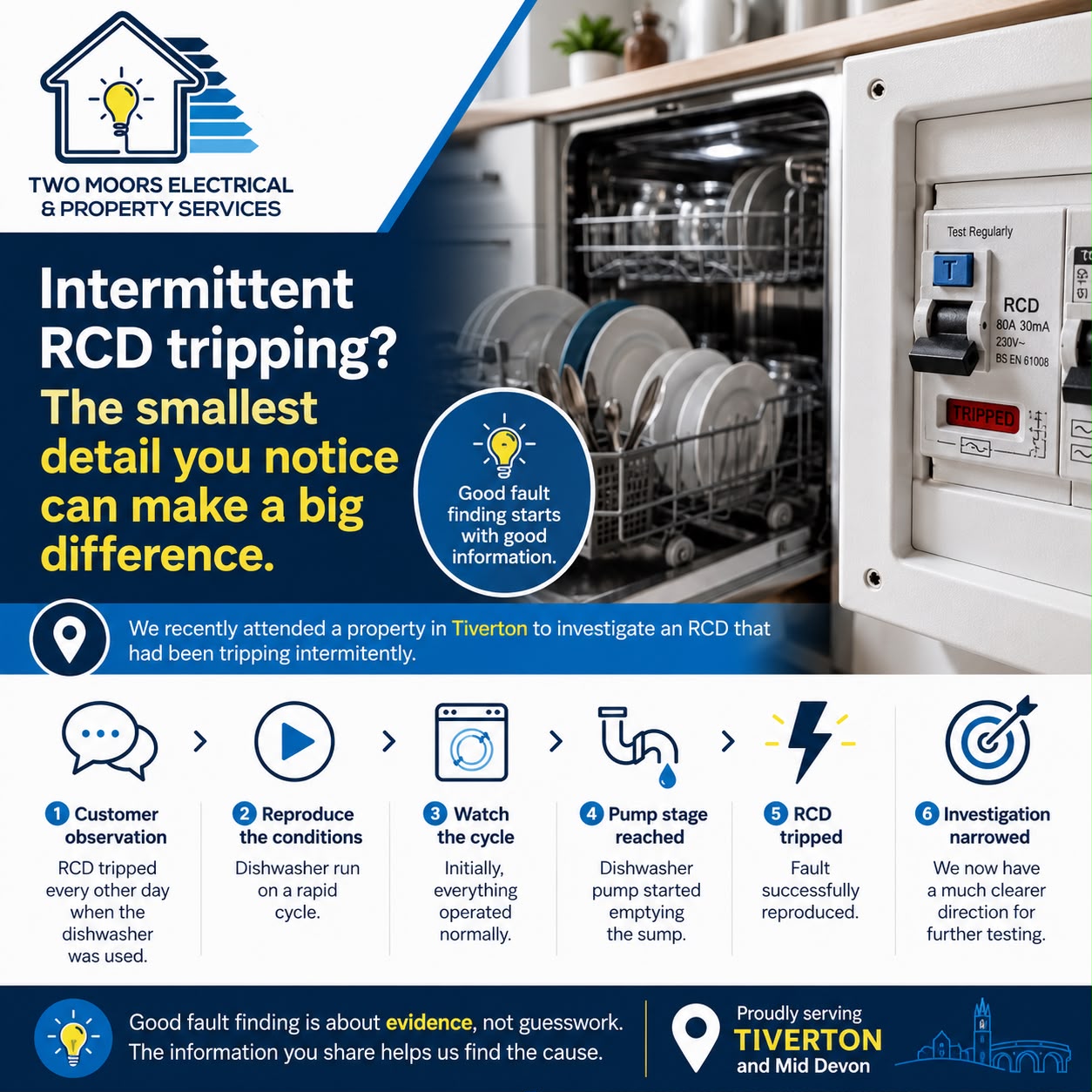
Rather than treating the previous RCD operations as random events, we deliberately ran the dishwasher on a rapid cycle so we could observe what happened as the appliance moved through its different operating stages.
Initially, everything worked normally.
The dishwasher ran and the RCD remained on.
When the cycle progressed to the stage where the pump began emptying the sump, the RCD tripped.
For the first time during the visit, the intermittent problem had been successfully reproduced.
That was an important step forward.
Why Reproducing an Intermittent Electrical Fault Is So Valuable
Reproducing a fault does not necessarily mean the investigation is complete.
What it does is turn an occasional problem into something that can be observed.
Before running the dishwasher, the evidence was that an RCD had been tripping intermittently and the customer had noticed a possible connection with dishwasher use.
After reproducing the condition, we knew something more specific: the dishwasher could initially operate normally, but the RCD trip occurred when the appliance reached the drain-pump stage of the cycle.
That information significantly narrows the investigation.
It does not, by itself, prove that the drain pump was definitively faulty or establish the final root cause. Further investigation is required to distinguish between the appliance, its components and any other factors associated with that stage of operation.
That distinction between evidence and conclusion is an important part of professional electrical fault finding.
How Electricians Diagnose Intermittent RCD Tripping in Tiverton
Good fault finding is a process of progressively reducing the number of possible causes.
In this case, the process started with the customer’s report of intermittent RCD tripping. Their observation provided a recurring association with dishwasher use, which gave us a condition we could deliberately recreate.
Running the rapid cycle then allowed us to observe the appliance rather than simply test it at one arbitrary moment.
When the RCD operated at a particular stage, the investigation became more focused.
This is very different from guessing which component might be faulty and replacing parts until the problem disappears.
Evidence allows each stage of an investigation to inform the next.
Good fault finding is about evidence, not guesswork.
The branded diagnostic graphic can be positioned here to illustrate the sequence: customer observation → reproduce the conditions → watch the cycle → pump stage reached → RCD trips → investigation narrowed. The graphic should be presented as an educational illustration, not as a photograph of the Blundell’s Road installation.
What Should You Tell an Electrician If Your RCD Only Trips Occasionally?
If you’re experiencing intermittent RCD tripping, you don’t need to work out what’s electrically wrong yourself.
What can be extremely useful is simply noticing what is happening around the fault.
Try to remember when the RCD operates and whether a pattern develops. Consider which appliances were running at the time, whether the same appliance seems to be involved repeatedly, and whether the trip occurs immediately or only after that appliance has been operating for a while.
With appliances that run through several stages, details about when the problem occurs can be particularly useful. Something that trips as soon as it is switched on presents a different set of evidence from something that operates normally for twenty minutes before the RCD trips.
Even apparently minor observations can help an electrician decide what conditions should be reproduced during the investigation.
The customer at the Blundell’s Road property wasn’t expected to know what was causing the problem. What mattered was that they had noticed a pattern and told us about it.
Intermittent RCD Fault Finding in Tiverton – Summary
Intermittent electrical faults can be frustrating precisely because they don’t always appear when someone arrives to investigate them.
This fault-finding visit in Tiverton demonstrates why the customer’s experience can become an important part of the diagnostic process.
The observation that the RCD appeared to trip while the dishwasher was operating gave us a useful starting point. By deliberately recreating those conditions and watching the dishwasher through its cycle, we were able to reproduce the RCD trip when the appliance reached its drain-pump stage.
That did not justify jumping immediately to a final diagnosis. It did something equally important: it provided evidence that allowed the investigation to become more focused.
If your RCD only trips occasionally, you don’t need to diagnose the problem before calling an electrician. Pay attention to the pattern. The details you’ve noticed about when, how often and under what circumstances it happens may be some of the most useful information you can provide.
Call us today on 01884 900139 or via our contact form