Why Customers in Mid Devon Can Be Concerned When an Electrical Project Has a Variation
Variations Explained - Two Moors Electrical
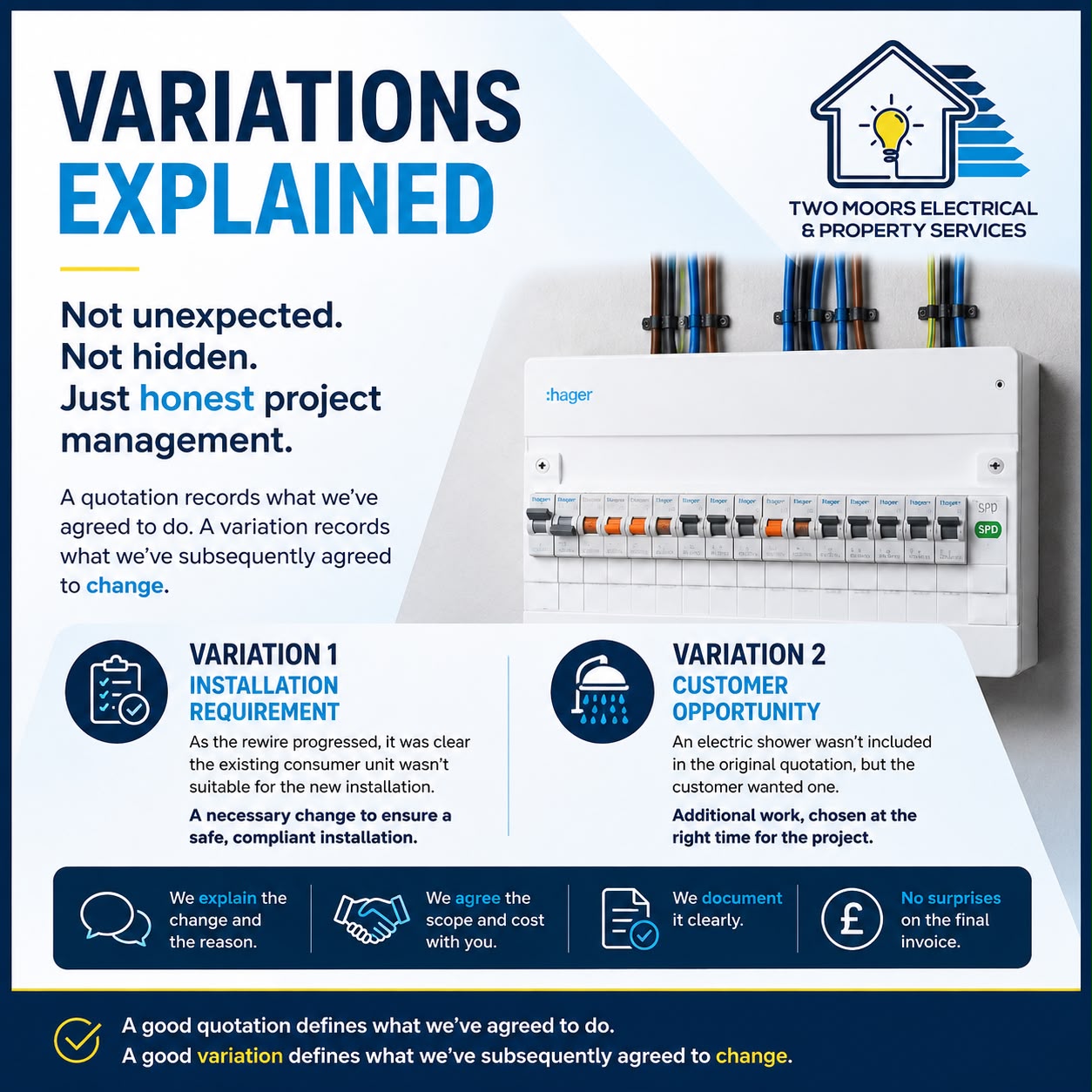
When you hear the word variation during an electrical project, it’s understandable to think it means the price is about to increase unexpectedly.
A professionally managed variation should mean something much simpler:
Something has changed from what was originally agreed, and that change needs to be explained, costed and agreed.
Variations don’t occur on every electrical project, but they can arise when circumstances change, new information becomes available or a customer decides they would like to alter the original scope.
During one full property rewire we carried out, two variations arose for completely different reasons. Together, they provide a useful example of why variations exist and how they should be managed.
How an Electrical Rewire Quotation Defines the Original Agreed Scope
Before a full rewire begins, the quotation establishes what the contractor and customer have agreed will be carried out.
That quotation can only be prepared using the information available, the customer’s requirements and the reasonable assumptions that can be made at quotation stage.
On this particular project, the original quotation allowed for the property’s existing consumer unit to remain.
That wasn’t subsequently treated as wrong simply because the project changed. It was the agreed position based on what was understood when the quotation was prepared.
As the rewire progressed, however, the requirements of the completed electrical installation became clearer.
That created the first variation.
Why the Consumer Unit Became a Necessary Variation During the Rewire
Once the new installation was being developed, it became clear that the existing consumer unit wasn’t suitable for the completed rewire.
It did not provide sufficient capacity for the required circuits, did not provide the required surge protection arrangement and was not the appropriate configuration for the installation being created.
At that point, the question was no longer whether the original quotation had been inaccurate.
The relevant question was:
What needs to change now that we have information we didn’t have when the original scope was agreed?
Replacing the consumer unit therefore became a necessary change to the project.
This is an important distinction. Electrical projects, particularly larger works such as full rewires, can reveal requirements as work progresses that could not reasonably have been established in exactly the same way beforehand.
A professional variation provides a clear way of documenting that change rather than allowing the scope and final cost to become unclear.
How a Customer-Requested Addition Created a Different Type of Rewire Variation
The second variation arose for a completely different reason.
During further discussions, it became apparent that the customer also required a new electric shower circuit. This had not formed part of the original quotation.
There wasn’t a fault in the original scope. The customer’s requirements had simply developed.
Because the property was already undergoing a full rewire, this was also the sensible time to consider the additional circuit. Cable routes were accessible and the building work was already in progress.
Leaving it until after the rewire was complete could have meant returning later and potentially disturbing finished walls or decorations to install something that could be incorporated much more practically during the existing works.
The customer could therefore make an informed decision about whether they wanted to add the shower circuit while the opportunity existed.
This was still a variation, but unlike the consumer unit, it was customer-requested additional work rather than a necessary change to the installation requirements.
What Should an Electrical Project Variation in Mid Devon Actually Tell the Customer?
The important part of managing variations isn’t simply identifying that something costs more.
The customer should be able to understand what has changed.
A well-managed variation should make clear what was included within the original quotation, what is now different, why the change has arisen and what the altered or additional work will cost.
The change can then be discussed and agreed before the additional work proceeds.
At Two Moors Electrical, variations are documented separately from the original quotation. Where applicable, they are also invoiced separately so there is a clear distinction between the work originally contracted and work subsequently agreed.
That creates transparency throughout the project rather than leaving the customer trying to understand unexplained additions on a final invoice.
Why Electrical Project Variations Protect Both Customer and Contractor
Variations provide clarity for everyone involved.
For the customer, they create a record of what has changed and provide an opportunity to understand the reason and cost before agreeing to proceed.
For the contractor, they clearly distinguish additional or altered work from the original scope.
Most importantly, they allow a project to adapt when circumstances genuinely change without losing control of what has been agreed.
This matters particularly on larger electrical projects and rewires across Mid Devon, where work can span several stages and decisions made during the project may affect later parts of the installation.
Good project management doesn’t mean pretending nothing will ever change. It means having a clear and transparent process for dealing with changes when they do.
Does a Variation Mean the Original Electrical Quotation Was Wrong?
Not necessarily.
A quotation is based on what has been agreed and what can reasonably be established at the time it is prepared.
If the customer subsequently asks for something different, the original quotation hasn’t become inaccurate. The scope has changed.
Likewise, if work reveals that an assumption within the original scope is no longer appropriate for the completed installation, that change needs to be addressed rather than ignored simply because it wasn’t included initially.
That is why one of the most useful distinctions for customers is:
A good quotation defines what we’ve agreed to do. A good variation defines what we’ve subsequently agreed to change.
Neither gives a contractor permission to carry out unspecified additional work and simply charge for it afterwards. The purpose of documenting the variation is precisely the opposite: to make the change visible and understandable.
Electrical Rewire Variations in Mid Devon – Summary
The two variations on this rewire arose for different reasons.
The consumer unit became a necessary project change when the requirements of the completed installation showed that retaining the existing board was no longer appropriate.
The electric shower circuit was different. It was additional work identified through further discussion with the customer, and completing it while the property was already being rewired provided a practical opportunity to avoid potentially disruptive work later.
Both changed the original scope. Both therefore needed to be explained, costed and agreed.
For customers undertaking rewires and larger electrical projects across Mid Devon, that’s the important point to remember about variations.
They shouldn’t be surprise extras appearing at the end of the job. They should provide transparency when something genuinely changes, allowing the customer and contractor to understand exactly what is different and agree how the project should move forward.
Electrical Project Variations: Frequently Asked Questions About Quotations and Additional Work
⸻
What is a variation on an electrical project?
A variation is an agreed change to the original scope of work.
Your quotation sets out the electrical work that has been agreed based on the information and requirements available at the time. If something subsequently needs to be added, removed or changed, that difference can be recorded as a variation.
A variation might arise because new information becomes available once work begins, an original assumption is no longer suitable, or you decide you’d like additional work carried out.
Why it matters: A good quotation defines what we’ve agreed to do. A good variation defines what we’ve subsequently agreed to change.
⸻
Does a variation mean the original quotation was wrong?
No, not necessarily.
A quotation is prepared using the information available and the work agreed at quotation stage. On some projects, particularly rewires and renovations, further information can become available once work is underway.
For example, during a full property rewire we originally allowed for the existing consumer unit to remain. As the requirements of the completed installation became clear, it was established that the existing consumer unit wasn’t suitable for the new arrangement.
The original quotation reflected what was understood at the time. The variation recorded what subsequently needed to change.
Why it matters: A genuine change in circumstances is different from an unexplained increase in the original price.
⸻
Why can the cost of an electrical project change after work starts?
There are several legitimate reasons.
Something that couldn’t reasonably be established beforehand may become apparent once work begins. The requirements of the completed installation may change, an assumption made during quotation may prove unsuitable, or the customer may request additional work.
The important point is that the reason for the change should be explained rather than simply appearing as an additional charge.
Why it matters: If the project cost changes, you should understand what has changed in the work as well.
⸻
Should my electrician tell me before carrying out additional work?
Wherever reasonably practicable, yes.
If additional or changed work will affect the agreed scope and cost, it should be identified and explained before that work proceeds.
A well-managed process should normally be:
Explain → Cost → Agree → Document
This gives you the opportunity to understand the change and make an informed decision before additional work is undertaken.
Why it matters: Variations should provide transparency, not create surprises when the final invoice arrives.
⸻
Do I have to agree to a variation?
Optional additional work should not simply be carried out without your agreement.
If you request an additional socket, circuit or other improvement that wasn’t included in the original quotation, the additional scope and cost should be agreed before proceeding.
Where a change is necessary for the agreed installation to be completed appropriately, your electrician should explain why the original plan needs to change and discuss the available options with you.
Why it matters: Necessary project changes and optional customer-requested additions are different, but both should be communicated clearly.
⸻
What’s the difference between necessary additional work and optional extra work?
A necessary variation arises when something about the project means the original agreed approach needs to change.
A customer-requested variation occurs when you decide to add or change something that wasn’t included in the original scope.
We encountered both during the same full property rewire. The existing consumer unit had originally been expected to remain, but the requirements of the completed installation meant it needed to be replaced. That was a necessary change to the planned installation.
Separately, an electric shower circuit was identified as something the customer wanted but which hadn’t been included in the original quotation. That was additional customer-requested work.
Why it matters: Clearly identifying why a variation has arisen helps you understand whether you’re dealing with a project requirement or a choice to expand the original work.
⸻
What happens if something unexpected is discovered during electrical work?
The first step should be to establish what has been found and whether it affects the agreed work.
Your electrician can then explain the issue, what it means for the project and whether any change to the original scope is required.
If additional work is proposed, its scope and cost should be discussed and agreed wherever reasonably practicable before proceeding.
Why it matters: Discovering something unexpected doesn’t mean the contractor should automatically carry out unspecified additional work. It means the new information needs to be assessed and communicated.
⸻
Why can’t every possible issue be included in the original quotation?
A quotation can only reasonably be based on what can be assessed and what has been discussed before the work begins.
Electrical installations are often concealed behind walls, beneath floors and within existing equipment. Larger renovation projects can also develop as building work progresses and customer requirements become clearer.
A thorough quotation should reduce uncertainty, but it can’t always reveal information that isn’t reasonably available until work starts.
Why it matters: Good project management isn’t about pretending unforeseen circumstances never occur. It’s about managing genuine changes properly when they do.
⸻
Can I add extra electrical work after accepting a quotation?
Yes.
Customers often think of additional requirements once a project is underway. These can usually be considered as variations to the original scope.
The additional work should be discussed to establish what is involved, whether it affects the existing programme and what it will cost.
Why it matters: A variation provides a clear way to expand a project without losing sight of what was included in the original quotation.
⸻
Is it better to add electrical work while a renovation or rewire is already underway?
Sometimes it can be significantly more practical.
During the rewire supporting this FAQ, the customer required an electric shower circuit that hadn’t been included in the original quotation. Because the property was already being rewired, it made sense to consider installing the circuit before walls and finished surfaces were reinstated.
Returning later could have involved disturbing completed finishes to install the same wiring.
That doesn’t mean every possible extra should automatically be added during a renovation. It means it’s worth considering future requirements while access is available.
Why it matters: Planning additional electrical work at the right stage can reduce disruption and avoid repeating work later.
⸻
What happens if the existing electrical installation isn’t suitable for what was originally planned?
The installation should be reassessed before simply continuing with the original plan.
Sometimes an existing component that was expected to remain proves unsuitable once the requirements of the completed work are established.
Your electrician should explain what has changed, why the original approach is no longer appropriate and what work is now proposed.
Why it matters: Continuing with an unsuitable original assumption simply to avoid a variation wouldn’t necessarily produce the right finished installation.
⸻
Why might a consumer unit become a variation during a rewire?
A quotation may sometimes be prepared on the basis that an existing consumer unit can remain.
As the rewire is developed, the completed installation may require a different number or arrangement of circuits, different protective equipment or other features that the existing consumer unit cannot appropriately accommodate.
In the project behind this FAQ, the existing consumer unit didn’t provide sufficient ways for the required circuits, didn’t provide the required surge protection arrangement and wasn’t the appropriate configuration for the completed rewire.
Its replacement therefore became a variation to the original scope.
Why it matters: The reason for replacing a consumer unit should be based on the requirements of the installation, not simply because a newer consumer unit is available.
⸻
How should an electrical variation be documented?
The variation should clearly identify what has changed from the original quotation.
At Two Moors Electrical, we document variations separately so the customer can see what was included originally, what has subsequently changed, why the change has arisen and what the additional work will cost.
Where relevant, it should also be clear whether the change is necessary for the project or has been requested by the customer.
Why it matters: Written documentation gives both the customer and contractor a clear record of how the agreed project has developed.
⸻
Should variations be invoiced separately?
They can be, and doing so can help keep the project finances clear.
At Two Moors Electrical, variations are invoiced separately where applicable so there’s a clear distinction between the original agreed work and subsequently agreed changes.
The important principle is transparency. However the project is invoiced, you should be able to understand what you’re being charged for and how it relates to the agreed work.
Why it matters: Clear documentation and invoicing make it easier to follow the financial progress of a larger electrical project.
⸻
Can a contractor simply add extra work to my final invoice?
Additional charges shouldn’t simply appear without explanation.
Where a change to the agreed work is identified, it should normally be explained, costed and agreed before the additional work proceeds wherever reasonably practicable.
There can be circumstances during a project where immediate decisions are required, but good communication should remain central to how any change is managed.
Why it matters: The purpose of a variation process is to prevent unexplained extras appearing at the end of a project.
⸻
What should I ask before agreeing to additional electrical work?
You should understand four things:
1. What has changed from the original quotation?
2. Why has the change arisen?
3. What additional work is being proposed?
4. What will it cost?
If the change is optional, you should also understand whether there are any advantages to completing it during the current project rather than returning to it later.
Why it matters: You don’t need to understand every technical detail, but you should understand what you’re agreeing to and why.
⸻
Are variations normal during full rewires and renovation projects?
They can occur, but they aren’t inevitable.
Larger electrical projects often involve existing buildings, concealed installations, other trades and customer decisions developing as the project progresses. That creates more opportunity for genuine changes than a small, tightly defined electrical job.
However, the possibility of variations shouldn’t be used as an excuse for poor quotation or unclear pricing.
Why it matters: A professionally managed project allows for genuine changes while keeping the original scope and any subsequent variations clearly defined.
⸻
How do variations protect the customer?
A properly managed variation creates a record of how the project has changed.
Instead of reaching the end of the work and discovering an unexplained additional charge, you can see what was originally included, what changed, why it changed and what additional cost was agreed.
It also provides an opportunity to discuss optional work before deciding whether you want it carried out.
Why it matters: Transparency gives you greater control over both the scope and cost of your project.
⸻
What’s the difference between a quotation and a variation?
A quotation defines the work and price agreed before the project begins.
A variation records a subsequent agreed change to that original scope.
The two documents therefore serve different purposes but work together to maintain a clear record of the project.
Why it matters: Keeping the original quotation and subsequent variations distinct makes it much easier to understand how a project and its final cost have developed.
⸻
How can I avoid unexpected costs during an electrical project?
Start with a clear quotation and discuss your requirements as fully as possible before work begins.
On larger projects, think about future requirements as well as immediate ones. Items such as additional circuits, electric showers, EV charging, outdoor supplies or planned alterations may be easier to incorporate while a property is already being rewired or refurbished.
Even with careful planning, genuine changes can still arise. If they do, ask for the change, reason and cost to be explained before additional work proceeds wherever reasonably practicable.
Why it matters: The aim isn’t to guarantee that a project can never change. It’s to make sure that if it does change, you understand and agree how it moves forward.
⸻
Electrical projects sometimes need to adapt as new information becomes available or a customer’s requirements develop. A variation is the mechanism for managing those changes clearly.
For homeowners undertaking rewires, renovations and other electrical projects in Mid Devon, the principle should remain straightforward: if something changes, you should understand what has changed, why it has changed, what it will cost and what you’re agreeing to before the project moves forward.
Call us today on 01884 900139 or via our contact form.